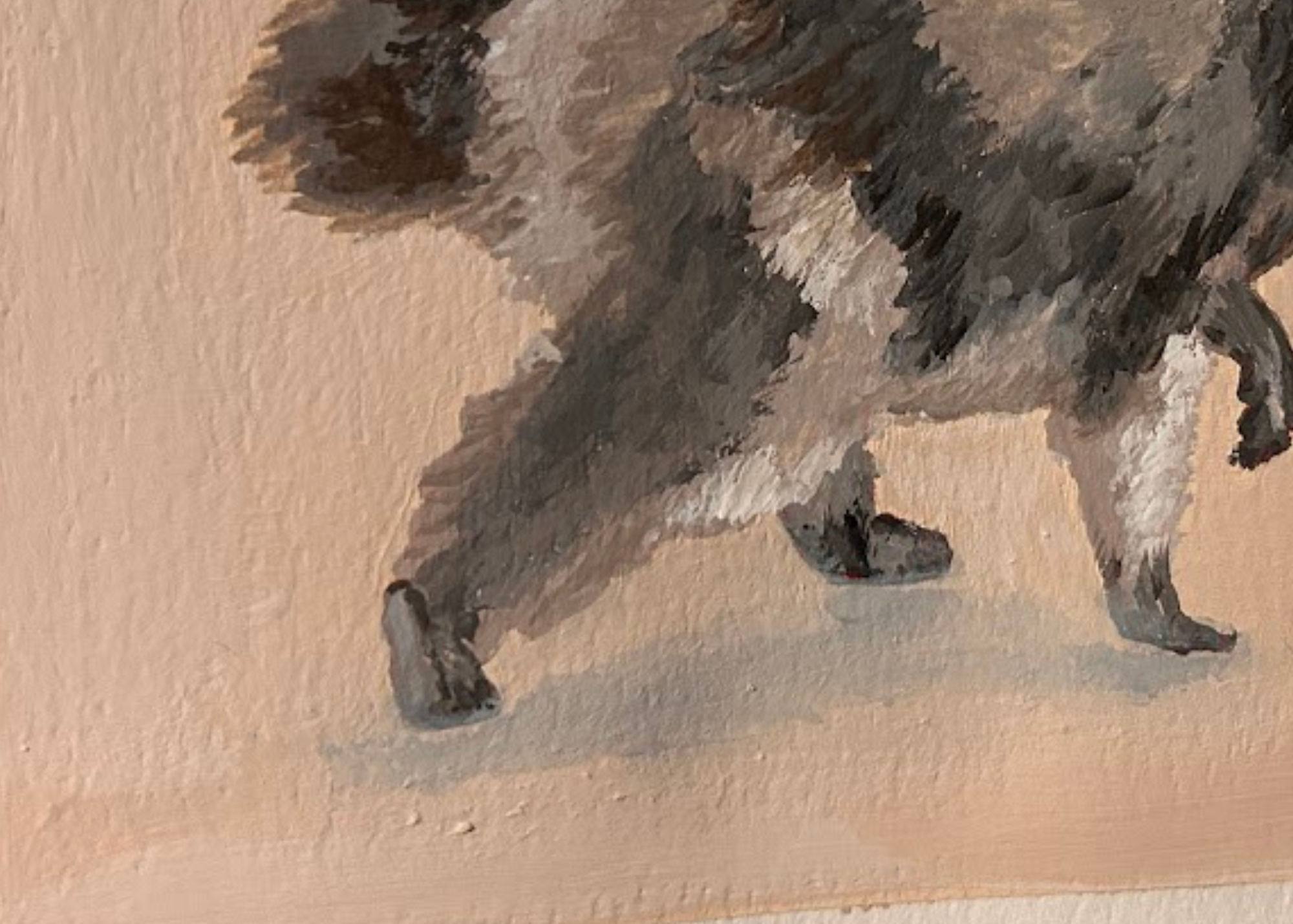
I recently ran into a problem I hadn’t experienced before while working on a small gouache painting: the paint cracked as it dried.
I was painting a light green object over a dark background. The background was painted with HIMI gouache, while I used Winsor & Newton gouache for the object. Because gouache can reactivate when it gets wet, I was concerned that adding too much water to the lighter paint would pick up the dark color underneath.
My solution was to use the Winsor & Newton gouache fairly thickly to get the opacity and clean edges I wanted.
It worked while the paint was wet. By the next morning, however, the light green areas had developed a network of fine cracks.
Why Did My Gouache Crack?
Traditional gouache can crack when it is applied too thickly. Gouache dries to a matte paint film, and a heavy layer can become brittle as it dries and contracts.
In my case, I also added more paint in areas where the first strokes didn’t give me the smooth coverage or clean edges I wanted. That created an even thicker layer in some places.
The result was a good reminder that more paint isn’t always the best way to get better coverage with gouache.
Cracks in the gouache
What I’ll Do Differently Next Time
For my next attempt, I plan to use just enough water to give the gouache a smooth, creamy consistency while keeping it opaque. If the first coat doesn’t provide complete coverage, I’ll let it dry before applying another thin layer instead of continuing to build up wet paint.
I’ll also avoid painting the dark background underneath areas that I know will eventually be a much lighter color. Leaving some of the white watercolor paper exposed should make it easier to achieve an opaque light color without using such a heavy layer of paint.
Can Cracked Gouache Be Fixed?
For now, I’m leaving the cracked paint alone. Adding water could reactivate the gouache and potentially loosen or disturb the already cracked surface.
Once the painting is finished, I’ll check whether the paint is stable before deciding what to do next. I already plan to repaint this particular piece, but I may keep the cracked version too. Sometimes a painting that doesn’t go as planned can still be useful, especially when it teaches you something for the next one.
Unfinished Gouache Painting “Pickle no good!”
If you’re learning to work with gouache too, you can also read my post, Does Gouache Reactivate With Water?, where I share more of what I’ve learned about layering and working with this medium.
Yes, traditional gouache can reactivate with water, even after it has dried. It’s one of the things that makes gouache such an interesting medium to work with, but it can also take some getting used to.
When I first started painting with gouache, I quickly learned that “dry” doesn’t necessarily mean permanent. If you add water or wet paint over a dried layer, some of that color can become workable again.
Sometimes that’s exactly what you want. Other times, not so much.
Why Does Gouache Reactivate?
Gouache is a water-based paint. Unlike acrylic paint, which becomes water-resistant once it dries, traditional gouache can usually be softened again with water.
That means paint that has dried on your palette can often be reused. Add a little water, give it some time to soften, and you may be able to paint with it again.
It also means dried paint on your artwork can reactivate.
If you brush a wet layer over an area you’ve already painted, your brush may pick up some of the color underneath. That can cause the two colors to blend or make the lower layer look disturbed.
Is Reactivating Gouache a Bad Thing?
Not necessarily. It can actually be useful.
I sometimes take advantage of it when I want to soften an area, blend an edge or make a small adjustment to something I’ve already painted. Being able to go back into a dry layer gives gouache a flexibility I really enjoy.
The challenge comes when I don’t want the first layer to move.
For example, if I’ve painted a dark background and then try to add a lighter color on top with a very wet brush, I can accidentally pull some of that dark paint into the new layer. Instead of getting a clean light color, I may end up with something muddy.
I’ve learned that the amount of water on my brush matters just as much as waiting for the first layer to dry.
Sometimes reactivation can actually work in your favor. With my goldfish painting below, for example, pulling some of the dark blue background into the white, flowy fins helped give them a more translucent look.
Work in ProgressFinished Painting
How Do You Paint Over Gouache Without Reactivating It?
You can’t always prevent gouache from reactivating completely, but a few things help:
Let the first layer dry completely. Painting over damp gouache will move the paint much more easily.
Use less water in your next layer. A wetter brush is more likely to disturb the paint underneath.
Try not to overwork the area. A few deliberate brushstrokes usually work better than repeatedly brushing over the same spot.
Use thicker paint for lighter details. If I’m adding highlights or light colors over something dark, I usually want the paint fairly opaque rather than heavily diluted.
And sometimes I simply leave an area alone and come back to it later. Gouache has taught me that continuing to fuss with a section isn’t always the best way to fix it.
Can You Rewet Dried Gouache on a Palette?
Usually, yes.
One of the nice things about traditional gouache is that dried paint doesn’t necessarily have to be wasted. You can often add water and work it back into a usable consistency.
How well it reactivates can depend on the brand, how long it has been dry and the particular color. Freshly squeezed paint and reactivated paint may not feel exactly the same, but dried gouache can still be very usable.
This is also one reason I enjoy working with jelly gouache. I keep the paints moist when I can, but if the surface begins to dry, water can help make the paint workable again.
Gouache Takes a Little Practice
Reactivation isn’t the only thing that took me some time to get used to. One of the biggest lessons I’ve learned with gouache is that the color you see while you’re painting isn’t always the color you’ll have once it dries.
Lighter colors tend to dry darker, while darker colors can dry lighter. I’ve learned to keep that in mind when mixing colors and building layers, especially when I’m trying to match a color I’ve already used. Because of that, I usually mix a little more paint than I think I’ll need and set some aside in a small airtight container. It saves me from trying to recreate the exact color later, especially when I’m adding shadows, fixing a mistake, or cleaning up lines as I put on the finishing touches.
The same is true of reactivation. Once I understood that a dry layer could become workable again, I stopped fighting the paint quite so much.
I learned when to use more water, when to use less, when to let a layer dry and, maybe most importantly, when to stop brushing over the same area.
That’s part of what I enjoy about gouache. It can be forgiving enough to let you go back and make changes, while still making you think about how each new layer will interact with the one underneath.
Like most things in painting, it gets easier the more you use it.
If you have shopped for art prints online, you may have come across the term “giclée.” It is often used alongside phrases like “fine art print” and “museum-quality,” but what does it actually mean?
A giclée print is a high-quality inkjet print created for fine art. Giclée printing is commonly used to reproduce original paintings, drawings, photographs, and other artwork because it can capture subtle variations in color, texture, and detail.
For artists, it provides a way to offer reproductions that remain true to the original work. For collectors, it offers an affordable way to own and enjoy an artist’s work without purchasing the original.
What Does Giclée Mean?
A giclée print is a high-quality reproduction of an original work of art. It is created using professional inkjet printing, archival-quality inks, and fine art paper or canvas.
Simply calling a print giclée does not guarantee its quality. The materials used, print quality, and accuracy of the reproduction are what really matter.
The original painting is the physical piece created by the artist. There is only one.
A giclée print begins with a high-resolution digital reproduction of that artwork. The image is then printed onto fine art paper or another archival surface.
A well-produced giclée can closely reproduce the colors and details of the original, but it should always be identified as a print rather than an original work of art.
Original Gouache Painting – Living His Best Life/JimothyMuseum-quality giclée print of my original gouache painting.
What Makes a Giclée Print Different From a Regular Art Print?
The biggest differences are usually found in the ink, paper, color, printing equipment, and quality of the original digital image.
Professional giclée printing typically uses pigment-based inks rather than the dye-based inks commonly found in standard consumer printing. Pigment inks offer better color stability and resistance to fading.
The paper matters just as much. Fine art giclée prints are generally produced on archival, acid-free papers designed for long-term display. These papers also provide a surface that can reproduce the texture and detail of the original artwork.
Professional printers use multiple ink colors and precise color management to reproduce a much wider range of tones than a basic home or commercial printer can produce. This is especially important when reproducing paintings with subtle color changes.
Original TexturePrint
What Does “Museum-Quality” Mean?
“Museum-quality” can mean different things depending on how a print is produced. When used to describe a fine art print, it generally refers to the quality and longevity of the materials used to produce it.
A museum-quality giclée print should use archival materials, including pigment-based inks and high-quality, acid-free paper. Careful color management and a high-resolution source image are also important.
These choices help the print maintain its color and appearance over time when it is properly displayed and cared for.
How Long Do Giclée Prints Last?
There is no single lifespan for every giclée print. Longevity depends on the inks, paper, printing process, framing, and the conditions in which the artwork is displayed.
Archival pigment inks and acid-free fine art papers are specifically chosen for their resistance to fading and deterioration. Proper framing and keeping artwork away from direct sunlight, excessive moisture, and extreme temperature changes can also help protect a print.
If longevity is important to you, look beyond the word “giclée” and check what materials the artist or printmaker actually uses.
Are Giclée Prints Worth It?
If you want a high-quality reproduction of an artwork without purchasing the original, a giclée print can be an excellent option.
They typically cost more than mass-produced posters or basic prints because of the materials, equipment, and production process involved. In return, you receive a print designed to reproduce the original artwork accurately and hold up well over time.
A giclée print also makes it possible to collect work from an artist you love when the original has already sold or is outside your budget.
What Should You Look for When Buying a Giclée Print?
Before buying, read the description carefully. A reputable artist or seller should clearly identify the piece as a reproduction and provide information about how it was produced.
Look for details about the paper, printing method, size, and whether the print is signed. You should also be able to tell whether the print is a limited edition or an open edition.
Most importantly, the listing should make it clear whether you are purchasing an original work of art or a reproduction/print.
Why I Offer Giclée Prints of My Original Paintings
I began offering museum-quality giclée prints because I wanted reproductions of my paintings to retain as much of the character of the originals as possible.
My original artwork is painted by hand, primarily in gouache or watercolor. The visible brushwork, paper texture, small color variations, and subtle details are part of each piece. When I reproduce an original, I want those qualities to carry through to the print.
My giclée prints are professionally produced from my original artwork on fine art paper. My artist mark from the original painting is reproduced on the front, and I personally hand-sign each print on the back. Most of them are open-edition prints, which means they are not limited to a predetermined number of copies.
The original painting will always be the only original. A giclée simply provides another way to collect and enjoy the artwork.
If you are considering an art print, understanding how it was made can help you know exactly what you are buying. Terms like “giclée” and “museum-quality” are useful, but the quality of the materials and the transparency of the artist or seller tell you much more.